
The hard shell vs soft shell roof top tent debate is one of the most common questions among outdoor retailers, wholesalers, and distributors sourcing products for the European and North American markets.
Both types are in high demand. Both have strong customer bases. But they are fundamentally different products — and stocking the right one (or both) can make a significant difference to your sales performance.
This guide breaks down every key difference to help you make the right sourcing decision for your business.
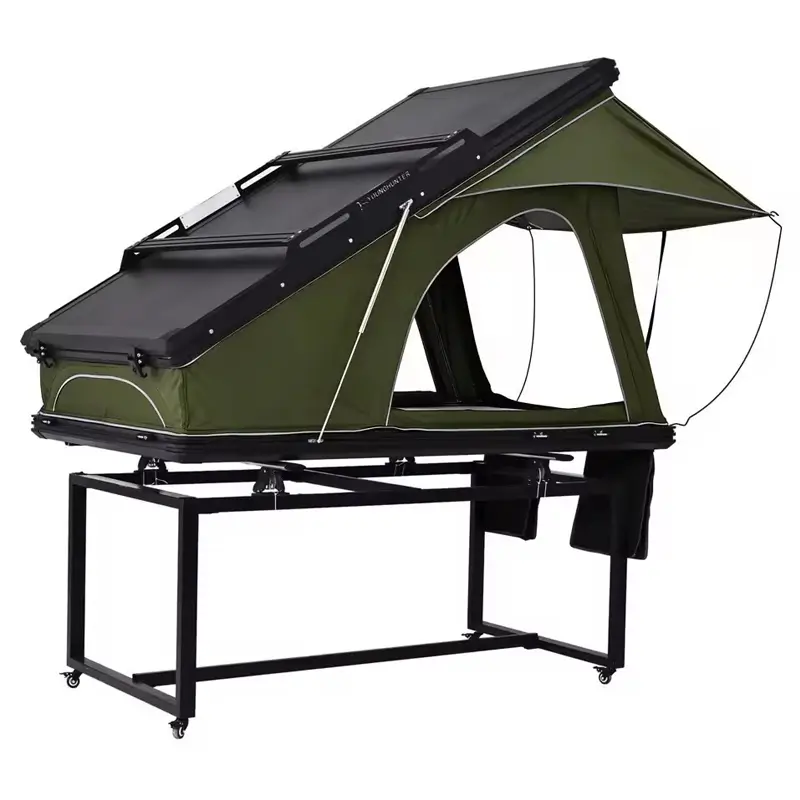
What Is a Hard Shell Roof Top Tent?
A hard shell roof top tent features a rigid outer casing — typically made from ABS plastic, fiberglass, or aluminum — that opens via gas struts when unlatched. The sleeping fabric is pre-attached inside and deploys automatically as the shell opens.
When closed, the hardshell roof top tent sits flat on your roof rack with a low profile of typically 8 to 14 inches, reducing wind drag and improving fuel economy during transit.
Key materials used in hard shell roof top tents:
- ABS Plastic — Acrylonitrile Butadiene Styrene, a high-impact thermoplastic known for its strength, rigidity, and resistance to mechanical stress. Rated for temperatures from -20°C to 80°C.
- Fiberglass — A composite material made of fine glass fibers embedded in resin. Lighter than steel, highly corrosion-resistant, and retains 95% of its mechanical properties after 25+ years of outdoor exposure.
- Aluminum — Lightweight, rust-proof, and structurally strong. Commonly used for the base frame and internal support structure.
Soft Shell Roof Top Tent
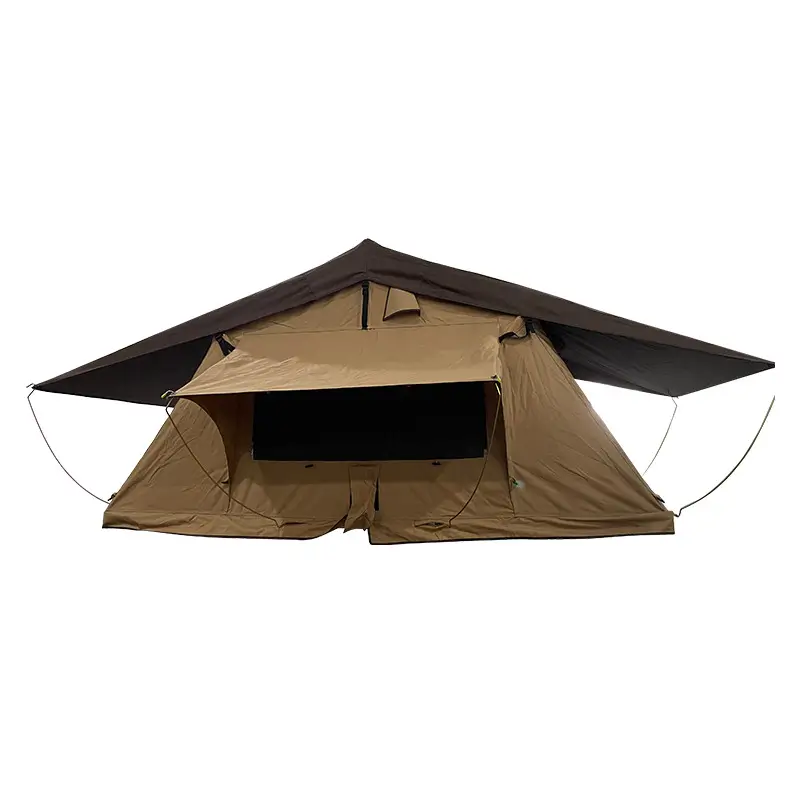
What Is a Soft Shell Roof Top Tent?
A soft shell roof top tent unfolds from a compressed stack — fabric walls, aluminum poles, and rainfly all deploy in sequence. The sleeping area extends beyond the vehicle roofline, typically opening to the side or rear, offering significantly more interior space than most hard shell models.
Soft shells are built from tough outdoor fabrics stretched over a lightweight aluminum frame, making them the preferred choice for family campers, overlanding groups, and budget-conscious buyers.
Key materials used in soft shell roof top tents:
- 600D Oxford Fabric — A heavy-duty synthetic textile with a denier rating of 600, offering high strength, abrasion resistance, and water resistance when coated with PU or PVC. The industry standard for outdoor tents and gear.
- Ripstop Polyester — A reinforced weave that prevents tears from spreading, ideal for high-stress areas of the tent fabric.
- Aluminum Frame — Lightweight and rust-resistant, providing the structural backbone of the soft shell design.
Head-to-Head Comparison
| Feature | Hard Shell | Soft Shell |
|---|---|---|
| Setup Time | Under 60 seconds | 3–5 minutes |
| Weight | 40–65 kg | 25–45 kg |
| Closed Profile | 8–14 inches | Higher / bulkier |
| Sleeping Capacity | 2 persons | 2–4 persons |
| Shell Material | ABS / Fiberglass / Aluminum | 600D Oxford / Ripstop |
| Weather Resistance | Excellent | Good |
| Aerodynamics | Superior | Moderate |
| Fuel Economy Impact | Low | Moderate |
| Wholesale Price | From $400 USD | From $140 USD |
| OEM / Private Label | ✅ | ✅ |
| Sample Order | ✅ | ✅ |
1. Setup Time — Hard Shell Wins
One of the biggest selling points of a hard shell roof top tent is its near-instant deployment. Simply unlatch the cover, extend the frame via gas struts, and lock it into position. The mattress stays inside at all times — no poles to insert, no fabric to tension, no guy lines to secure.
Hard shell setup: under 60 seconds.
A soft shell roof top tent takes 3 to 5 minutes to set up. You manually unfold the fabric canopy, slot in the support poles, raise the structure, and secure the guy lines if needed. Still far faster than a traditional ground tent — but the difference matters to frequent campers.
For retailers: The “60-second setup” is one of the most powerful conversion points when selling hard shells in the premium segment. Make sure it’s front and center in your product listings.
2. Weight & Vehicle Compatibility — Soft Shell Wins
Hard shell roof top tents typically weigh between 40 and 65 kg, making installation and removal a two-person job. They are best suited to vehicles with higher roof load ratings — full-size trucks, SUVs, and 4x4s.
Soft shell roof top tents range from 25 to 45 kg, making them easier to mount, remove, and reposition. This lighter weight makes them compatible with a wider range of vehicles, including mid-size SUVs and crossovers with lower roof load capacities.
For retailers: Soft shells unlock a larger addressable market. Any customer with a roof rack is a potential buyer — not just those with heavy-duty vehicles.
3. Weather Resistance & Durability — Hard Shell Wins
The rigid exterior of a hardshell roof top tent provides superior protection in harsh conditions — heavy rain, snow, hail, and intense UV exposure. The double-walled construction with insulation between layers also helps regulate interior temperature in both hot and cold climates.
Soft shell fabrics, while built to high standards using 600D Oxford with PU coating, are more susceptible to long-term wear from prolonged UV exposure and heavy rain. They require more maintenance over time compared to a hard shell.
For retailers: In markets with harsh or unpredictable weather — such as the UK, Germany, Scandinavia, or Canada — hard shells are significantly easier to sell and generate fewer warranty claims.
4. Interior Space & Capacity — Soft Shell Wins
A 2 person hard shell roof top tent is the most common configuration available. The rigid clamshell design limits how large the sleeping area can grow before the weight and bulk become unmanageable.
Soft shells extend outward from the vehicle and can comfortably accommodate 2, 3, or 4 persons. Larger family configurations — including annex rooms that attach below the tent — are almost exclusively available in soft shell designs.
For retailers: If your customer base includes families, group travelers, or overlanding clubs, soft shells are your primary recommendation.
5. Price Point — Soft Shell Wins
Hard shell roof top tents carry a higher manufacturing cost, which naturally positions them in the premium retail segment.
Soft shells offer a more accessible entry price, making them suitable for a broader range of buyers — from first-time campers to budget-conscious overlanding enthusiasts.
Wholesale pricing:
- Hard shell roof top tent: from $400 USD
- Soft shell roof top tent: from $140 USD
For retailers:
- Soft shells → Higher volume, broader customer base, faster turnover
- Hard shells → Higher margin per unit, premium positioning, stronger brand differentiation
6. Aerodynamics & Fuel Economy — Hard Shell Wins
When closed, a hard shell roof top tent sits flat and low on the roof rack — typically 8 to 14 inches in profile. This significantly reduces wind drag compared to a bulkier soft shell, resulting in better fuel economy for customers who keep their tent mounted year-round.
For customers who drive long distances between campsites — or use their vehicle daily with the tent attached — this is a practical and measurable advantage.
For retailers: A compelling selling argument for daily drivers, long-distance overlanders, and eco-conscious buyers.
Which One Should You Stock?
| Customer Profile | Best Choice |
|---|---|
| Frequent campers who value speed | Hard Shell |
| Budget-conscious first-time buyers | Soft Shell |
| Families and groups (3–4 persons) | Soft Shell |
| Harsh weather markets (UK, Germany, Canada) | Hard Shell |
| Premium / brand-focused retailers | Hard Shell |
| High-volume broad market | Soft Shell |
| Full market coverage | Both |
For most distributors and retailers, stocking both hard shell and soft shell roof top tents is the most effective strategy — giving you full market coverage across all customer segments and price points.
FAQ: Hard Shell vs Soft Shell Roof Top Tent
Q: What is the difference between a hard shell and soft shell roof top tent? A: A hard shell roof top tent uses a rigid ABS or fiberglass casing that deploys in under 60 seconds. A soft shell uses fabric walls supported by poles and takes 3–5 minutes to set up, but offers more interior space and a lower price point.
Q: Which roof top tent is better for harsh weather? A: Hard shell roof top tents offer superior weather resistance thanks to their rigid exterior and insulated double-wall construction. They are the preferred choice for buyers in wet or cold climates such as the UK, Germany, and Canada.
Q: What is the best hard shell roof top tent for 2 persons? A: A 2 person hard shell roof top tent with ABS or fiberglass shell, gas strut opening, and integrated mattress is the most popular configuration for couples and solo overlanders who prioritize quick setup and premium comfort.
Q: Can I order a sample before placing a bulk wholesale order? A: Yes. Sample orders are welcome for both hard shell and soft shell roof top tents. This allows you to evaluate product quality before committing to a larger wholesale purchase.
Q: Is OEM customization available for roof top tents? A: Yes. Both hard shell and soft shell roof top tents are available with full OEM and private label customization — including your brand logo, color options, fabric choice, and custom packaging.
Sourcing Hard Shell & Soft Shell Roof Top Tents — For Wholesalers & Distributors
Looking for a reliable roof top tent supplier based in China?
Whether you are a roof top tent wholesale buyer building out your product range, an outdoor brand seeking OEM roof top tent manufacturing, or a roof top tent dealer expanding into the overlanding category, S.V ChinaCarPart has been a trusted China export partner since 2014.
As a professional automotive outdoor equipment export company, we work with certified manufacturing partners and manage the entire export process — from factory production to international shipping, customs clearance, and documentation — so your sourcing experience is smooth from start to finish.
Why distributors and retailers choose us:
- 🏭 Certified manufacturing partners — quality you can verify before you commit
- 🚢 10+ years of export experience — shipping, customs & documentation fully managed
- 🎨 OEM & private label support — your brand, your specs, your packaging
- 📦 Flexible order quantities — sample orders welcome, bulk wholesale ready
- 🕐 24-hour after-sales support — real people, real responses, every time
We supply to:
- Outdoor & camping retailers across the US, UK, Germany, and Australia
- Wholesale distributors expanding into the overlanding and car camping category
- E-commerce brands seeking private label roof top tent manufacturing
- Importers and dealers looking for a dependable China roof top tent supplier
📩 Contact us via WhatsApp or Email to receive your wholesale product catalog, pricing list, OEM options, and shipping quote to your destination.
💬 We respond within 24 hours. Every time.
S.V ChinaCarPart — One-stop export partner for automotive outdoor equipment. Roof top tents, roof boxes, cross bars, bed liners, and car floor mats. Serving wholesalers and retailers across Europe and North America since 2014.